Retail & Office Fitout Trends Brisbane Businesses Are Backing in 2026
If you're comparing commercial fitout companies in Brisbane right now, you've probably noticed the brief has changed. Two years ago the conversation was almost entirely about fixed desks and shopfront signage. In 2026 it's about flexibility, wellbeing and getting a return on every square metre, because the cost of that square metre has kept climbing. Whether you're building out a CBD office floor or refitting a retail tenancy in Fortitude Valley, the office fitout ideas landing budget approval this year aren't the flashiest ones. They're the ones an operations manager can defend in a board meeting.
Brisbane is still one of the more affordable places in the country to fit out a commercial space. Knight Frank's most recent benchmarking puts Brisbane and Perth level as the cheapest CBD markets in Australia for office fitout, at roughly USD $934 per square metre, against USD $1,334 in Sydney and USD $1,300 in Melbourne. That's close to a 30 percent gap. Knight Frank's Queensland team describes Brisbane as "cost efficient yet increasingly supply constrained," which is a polite way of saying the discount won't last forever. Construction cost escalation is forecast to run between 4 and 6 percent through 2026, driven by ongoing infrastructure work, tighter supply chains and a persistent shortage of skilled trades in the sector. You can also explore our detailed breakdown on office fitout cost Brisbane 2026 pricing benchmarks for itemised budget tiers.
Where the retail fitout Brisbane budget actually goes
Before getting into trends, it helps to know where the money lands, because that's what shapes which ideas are worth chasing. Industry cost benchmarking from JLL breaks a typical commercial fitout budget down to roughly 41 percent builder's works (walls, ceilings, services, joinery installation) and about 23 percent furniture, fixtures and equipment. The rest covers design fees, project management, technology and contingency. That means the trends with the biggest visual impact, like feature joinery or statement lighting, are usually competing for a slice of that 23 percent FF&E line, not the structural budget. If your fitout partner is quoting a full refit at a price that seems too good, ask which line item they've trimmed to get there.
Retail spending is also giving landlords and tenants more confidence to invest. Household retail turnover in Australia hit AU$38.63 billion in January 2026, up 5 percent year-on-year, and non-residential building activity rose 0.3 percent to AU$17.0 billion in the December 2025 quarter. Woolworths alone renewed 68 supermarkets and opened 100 Mini Woollies convenience formats in FY2025, while Coles renewed 60 supermarkets and 118 liquor stores. When the majors are refreshing at that pace, independent retailers in Brisbane's suburban strips, from James Street to Toowong, are feeling pressure to keep their own retail fitouts current or lose foot traffic to the tenancy next door.
Activity-based working is replacing the fixed floor plan
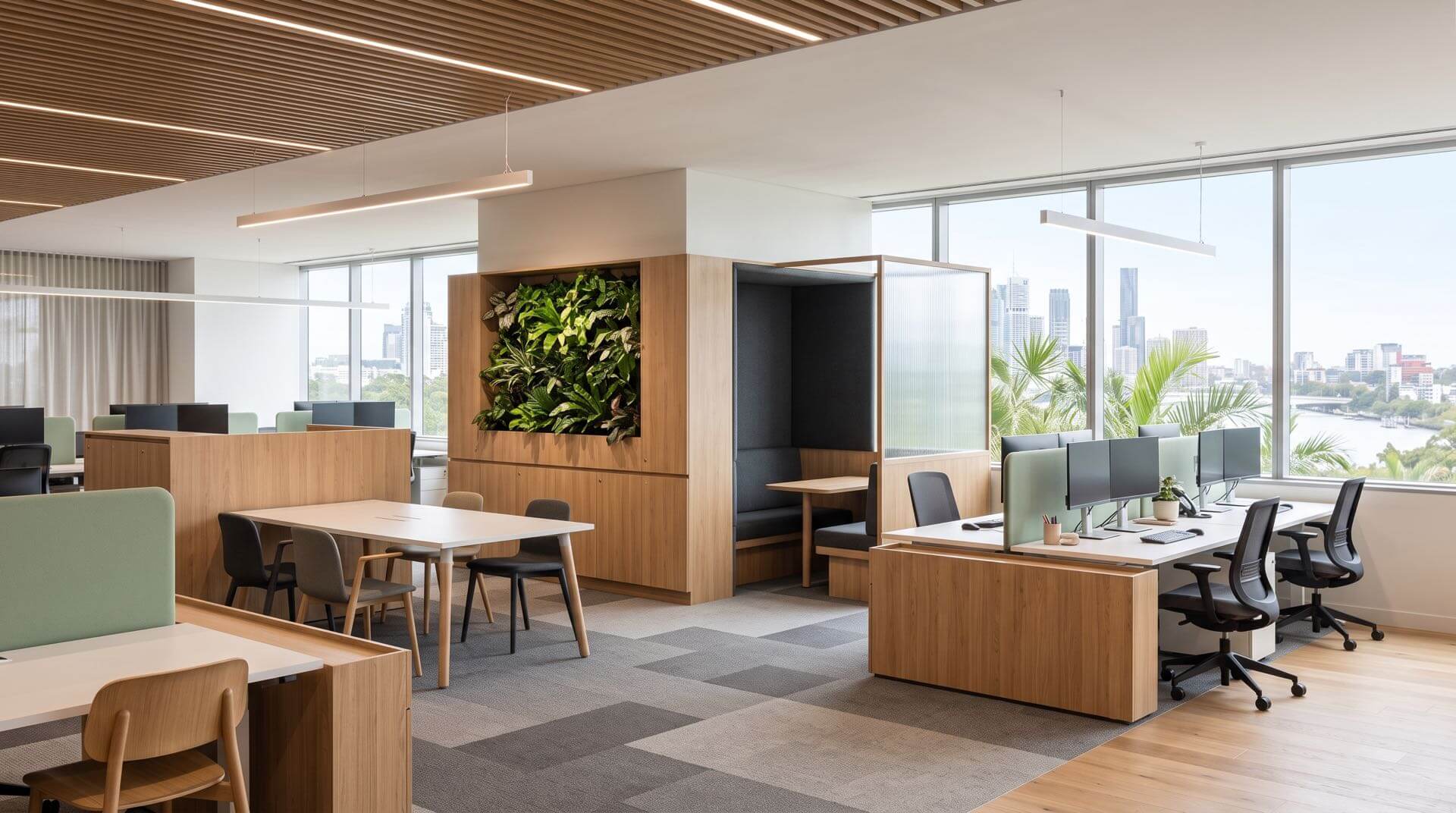
The single biggest shift in office fitout ideas for 2026 is the move away from a desk-per-head layout toward activity-based working zones. Instead of one open-plan floor, Brisbane offices are being carved into focus zones for heads-down work, collaboration spaces for team projects, informal breakout areas and enclosed quiet booths for calls. It's a direct response to hybrid work: if half the floor is empty on a Monday and full on a Wednesday, a rigid desk allocation wastes rent. Activity-based zoning lets the same footprint flex around actual attendance patterns instead of a headcount spreadsheet from three years ago.
Meeting rooms are getting the same treatment. Integrated video conferencing, interactive digital whiteboards and wireless presentation systems are becoming standard rather than optional extras, because a meeting room that only works well for the people physically in it isn't doing its job anymore. Smart room booking and occupancy sensors are also showing up in mid-tier fitouts, not just premium ones, largely because the technology has become cheap enough to justify the metering it enables. Take a look at our recent commercial fitout projects to see how modern flexible layouts are implemented in practice.
Biophilic design has moved past the token pot plant
Brisbane's subtropical climate gives local fitouts a genuine advantage here that colder cities can't easily copy. Living walls, integrated planting in breakout booths and generous natural light are turning up across both retail and office projects, and they're not purely decorative. Quiet recharge rooms and small wellness spaces are increasingly part of the brief for larger tenancies, reflecting a broader push to treat staff wellbeing as a fitout line item rather than an HR policy that sits separately from the physical space.
Warm materials are replacing the all-white shopfront
On the retail side, the aesthetic pulling ahead in 2026 is warm minimalism: natural timber finishes, stone benchtops, neutral palettes and soft, layered lighting rather than one harsh bank of downlights. Fluted timber panelling is showing up as a feature surface in fitting rooms and service counters because it adds texture without adding visual noise. Open, modular shelving that can be reconfigured for a new range or a seasonal reset is replacing fixed joinery, which matters in Brisbane retail strips where tenancies often turn over stock categories faster than the five-to-seven-year fitout depreciation cycle assumes.
Sustainability credentials have also become a genuine selling point rather than a box-ticking exercise. FSC-certified timber, recycled materials and low-VOC finishes are increasingly specified by default, partly because commercial landlords are asking for them as part of green lease conditions, and partly because customers notice. A shopfront that smells like fresh paint on opening day isn't the flex it used to be.
Compliance still decides your timeline, not your designer
None of this matters if the approvals process derails your opening date, and this is where a lot of first-time fitout clients get caught out. In Brisbane, commercial fitout work generally needs building approval from a private certifier before it can proceed, and the certifier is responsible for lodging the building certification documents with Brisbane City Council, which must happen within five working days of the associated work taking place. The council's online lodgement fee for building certification currently sits at $78.80, which is a small cost next to the fitout budget but a real risk if it's missed and holds up your certificate of occupancy. If you're planning a shop fitout in Brisbane, compliance also means checking your specific use class against the National Construction Code and any conditions attached to the tenancy's existing development approval, because a change of use (say, from retail to food and beverage or hospitality fitouts) can trigger a fresh round of approvals even if the physical works look minor.
The practical takeaway: build certifier lead times into your project program from day one, not as an afterthought once the design is locked. A licensed commercial fitout company in Brisbane will already have a certifier relationship and can tell you within the first design meeting whether your intended use, egress and accessibility requirements are likely to be straightforward or are going to need extra time. Review our fitout compliance FAQs for detailed guidance on QBCC requirements and certifier workflows across all Brisbane service areas.
What this means if you're planning a fitout this year
If you're weighing up office fitout ideas or a retail refresh for 2026, the sites worth prioritising are the ones that do double duty: activity-based zoning that also reduces your floor footprint and therefore your rent exposure, biophilic elements that support wellbeing without a large ongoing maintenance cost, and material choices that will still look considered in five years rather than dated in eighteen months. Brisbane's cost advantage over Sydney and Melbourne gives local businesses more room to invest in these choices properly, but that advantage is narrowing as construction costs rise through 2026. Get your certifier and your design brief moving together, not one after the other, and you'll avoid the two most common causes of fitout blowouts: change-of-use surprises late in the process, and a design that gets value-engineered down to something nobody actually wanted.
Brisbane businesses that treat their fitout as a long-term asset, rather than a one-off cost to minimise, are the ones getting the best outcomes from this year's trends. The rest are quietly redoing feature walls in 2028. Ready to start? Contact Brisbane Fitout Co for a fixed-scope consultation and site assessment.
Published By
Brisbane Fitout Co
QBCC Licensed Commercial Fit-Out Specialists across Brisbane.